

Workplace Practice
What If Improv Isn’t About Being Funny?
It may be a way to practice the behaviors that make workplace relationships stronger.

Most people hear “improv at work” and picture a team-building afternoon full of forced laughter, imaginary props, and someone’s manager pretending to be a helicopter.
That’s the assumption worth questioning.
Because the research points somewhere far more useful than comedy. Improv may be one of the few activities that lets people deliberately practice the behaviors that make workplace relationships stronger. Not “be funnier at standup.” Not “think faster on your feet.” Something quieter and much more valuable: how we show up for the people around us.
The Science Behind It
Jordana Cole’s research at the University of Pennsylvania examined exactly this question. Her 2016 master’s capstone research synthesis, I’ve Got Your Back: Utilizing Improv as a Tool to Enhance Workplace Relationships, pulled together established findings from positive psychology, mindfulness, and constructive communication to look at what improv actually trains.
Not performance. Relationship skill.
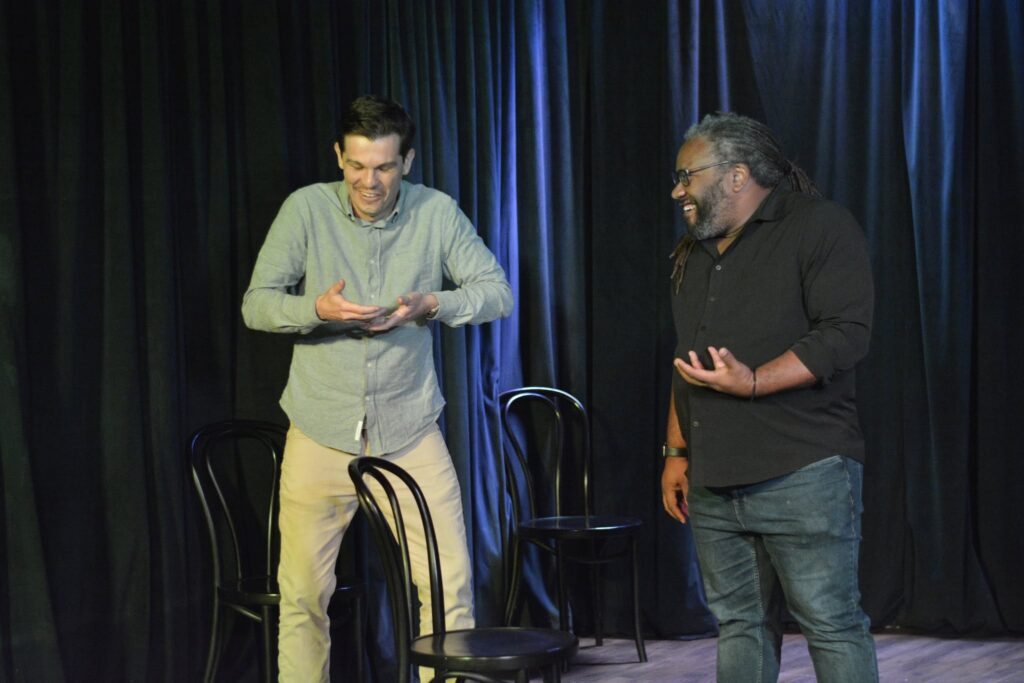
Her synthesis identifies three specific capacities that improv gives people repeated practice in:
- Presence
- Paying attention to what is happening right now, rather than rehearsing your next line in your head.
- Co-creation
- Building with another person’s contribution instead of around it or over it.
- Heightening
- Noticing what someone offers and adding to it, so the idea becomes more than either of you brought in alone.
Read that list again and notice how little of it is about being funny. These are the mechanics of good collaboration. They’re also the mechanics of trust. And they’re almost never taught directly, because they’re hard to lecture someone into.
What Most People Miss
Here’s where the usual approach goes wrong.
These aren’t skills you practice once at an offsite and suddenly master. Nobody becomes a better listener because they spent three hours in a conference room doing “yes, and” exercises and then went back to their desk. Behavioral change doesn’t work that way.
We get better at what we practice. Repeatedly. In small doses. In real situations.
Which means the value of improv isn’t the workshop. It’s what the workshop makes possible if you keep going, and what falls apart if you don’t.
Four Ways to Actually Apply It
Level 1: Listen all the way to the period
Most of us don’t listen. We wait, while preparing our response. Half our attention is on the other person and half is on the reply we’re drafting, which means we’re responding to a partial version of what was said.
Improv forces presence, because you can’t build on something you didn’t actually hear.
Try this
In your next conversation, don’t formulate your response until the other person finishes. All the way to the period. It’s harder than it sounds, and it changes what you hear.
Level 2: Make the idea bigger before you make it better
We’re trained to evaluate. Someone shares a thought and our first instinct is to assess it (good, bad, workable, not workable), usually within about two seconds.
Improv asks a different question first.
Try this
Instead of immediately judging someone’s contribution, ask, “What could we build from this?” You don’t have to commit to the idea. You just have to be curious about it before you critique it. The goal is practicing curiosity before judgment, because judgment is already a reflex and curiosity isn’t.

Level 3: Remember what your response teaches
This is the one worth sitting with.
Your response teaches people whether it’s safe to bring you another idea.
When someone shares an idea, an accomplishment, or a concern, you have three options. You can shut it down. You can minimize it. Or you can build on it. That choice is made dozens of times a day, usually without thinking, and it accumulates into a reputation people carry into every future conversation with you.
Try this
Respond with curiosity before critique. Especially when the idea isn’t good. Especially then.
Level 4: Don’t make improv an event. Make it a practice
One-time workshops don’t produce lasting behavioral change. What changes behavior is what gets woven into the ordinary rhythm of the work: how meetings open, how feedback gets delivered, how people respond when someone takes a risk.
That means the practice has to live in your week, not in a calendar invite from eighteen months ago.

The Real Point
Improv at work isn’t about entertainment. It’s a rehearsal space for the interpersonal skills that determine whether a team can think together: presence, co-creation, and the discipline of building on what someone else offers rather than replacing it.
And like anything worth being good at, it only counts if you keep practicing.
So if your team could practice one workplace skill through improv, which would it be? Listening, creativity, collaboration, or thinking on your feet?
Pick one. Then make it a practice, not an event.